
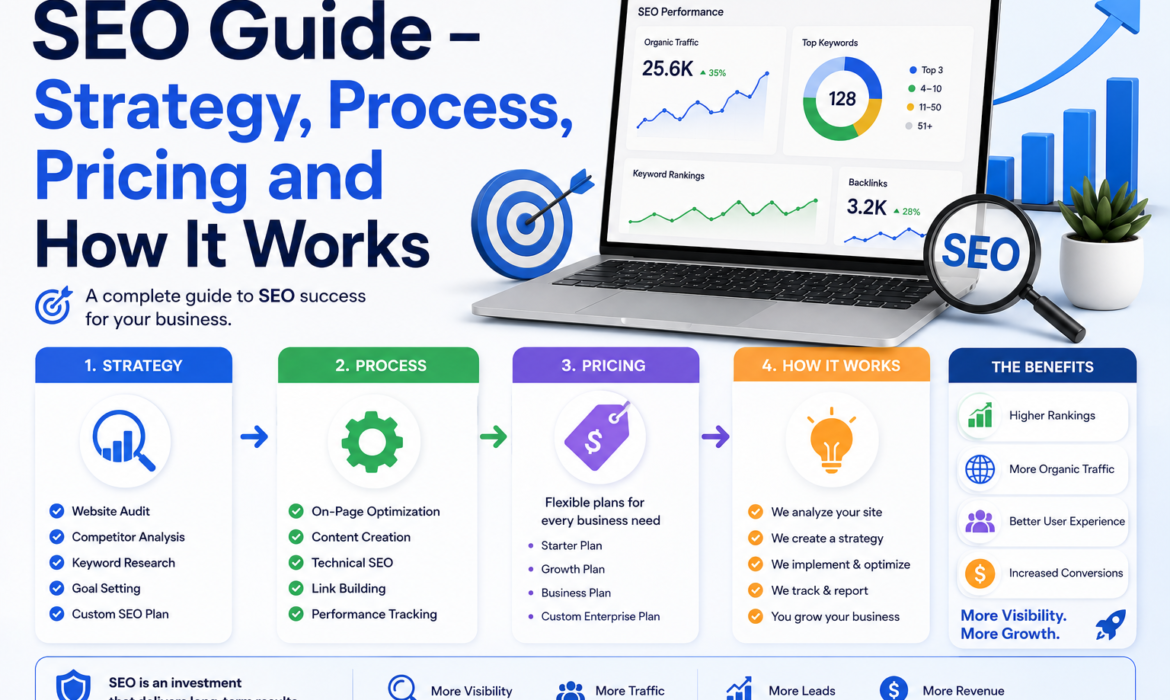
Want to improve your visibility on Google? Most businesses don’t struggle because SEO doesn’t work. They struggle because SEO is often executed without a clear strategy behind it. Google doesn’t reward pages simply because they exist. Search engines tend to prioritize content that demonstrates a deeper and more comprehensive understanding of a topic.
Table of Contents
ToggleAdditionally, search engines are now extending into AI-driven search systems, where content is reviewed not only for keywords but also for clarity, structure, and how well it answers a topic in context.
SEO is not a single activity. It’s a mixture of content strategy, technical setup, and authority signals working together over time. When these elements are misaligned, even well-written content fails to perform.
In this comprehensive guide, we will go through what SEO services actually perform well today, how each part matters to visibility on Google and AI search systems, and how to evaluate what’s truly driving results versus what is just activity without impact.
What Are SEO Services?
SEO services are the strategies that are applied to enhance a website’s visibility in search results. SEO services do not refer to a single task; they typically encompass keyword research, content optimization, brand mentions, technical improvements, website audits, link building, and performance tracking. Each service targets a different category of search visibility, but they work together toward the same goal: helping a website attract more relevant traffic from search engines.
The exact services required can vary depending on the niche, the website, the industry, and the business goals. For instance, a local business may benefit more from local SEO, while an e-commerce website may require extensive content and technical optimization. Understanding what each SEO service does is the first step toward building an effective SEO strategy.
Why Businesses Need SEO Services
Businesses need SEO services to improve their visibility and rankings within their niche. Each business requires different SEO services to improve online visibility.
The purpose is to connect with real buyers when they need a solution. Let’s clarify the benefits of SEO services that help you decide what you need to do next.
- Increase visibility and organic traffic.
- Improve trust and credibility.
- Enhance user experience.
- Cost-Effectiveness.
- High Conversion Rate.
- Local Dominance.
Understanding the competitive landscape is necessary for profitable growth. If you are interested in learning about where your digital presence stands, we can help you.
Complete Breakdown of SEO Services
Search engine optimization services are digital marketing solutions designed to improve a brand’s organic visibility on SERP such as Google, Bing, Yahoo, Yandex, etc. The main goals are to generate organic traffic, build brand authority, and generate leads and conversions by aligning the content according to search algorithms.
SEO services are generally divided into three main pillars. However, these pillars are further divided into subtypes that an expert and competent digital marketing agency can understand better. Let’s take a closer look at each category and subtype.
On-Page SEO
Optimizing particular pages on your site, adding content on relevant topics, and using HTML source code to rank for specific queries.
- There are several variations, such as keyword research, mapping high-volume keywords with low keyword difficulty in your content, doing internal and external linking, optimizing headings such as H1, H2, and H3, and adding alt text, title tags, and meta descriptions.
Off-Page SEO
Off-page SEO comes in when brands want to build authority and credibility across the internet. It builds trust and user engagement that signal to Google your trustworthiness.
- Main tasks include link building, guest posting, niche edits, forum backlinks, digital PR comment backlinks, profile backlinks, and PDF backlinks.
Technical SEO
As the name suggests, it refers to optimizing your site’s backend structure to make sure Google can easily find, crawl, and index your webpages.
- The key services include XML sitemap creation, fixing core web vitals issues, site speed optimization, mobile friendliness, and schema (structured data).
Specialized SEO Services
Local SEO
If you want to run your business locally within your city or area, you need a local SEO service. Let us simplify it for you. Local SEO improves your online presence, so local customers can find your business in nearby searches. It includes:
- Google Business Profile
- Handling local customer reviews
- Local directory listings and citations
E-commerce SEO
Optimizing an e-commerce website’s category and product pages to show in search results while a customer searches for the service. Here are some services:
- Product description optimization
- Product schema markup
- Faceted navigational issues
- Content pruning
Enterprise SEO
Enterprise SEO focuses on large websites with thousands of pages and complex site structures. Its key services are the following:
- Managing large website structures
- Programmatic content optimization
- Dealing with complex URL redirects
Content Strategy
Writing authoritative and value-packed content that fulfills users’ actual intent and satisfies AI search engines.
- Blog post/article writing
- Content audits
- Topic clustering
- Refining existing pages
How SEO Services Work Together
SEO is a package of different services that work together to keep your site visible on Google from scratch. Not every business focuses on each aspect of SEO, but consistent growth comes from combining multiple services that support each other.
Technical SEO helps search engines crawl, index, and review your website pages. If your site faces technical issues, the pages won’t be visible, and even if your content is accurately optimized, it will still struggle to rank.
On-Page SEO is used to understand the relevance and intent of your content. It includes mapping related keywords and optimizing headings, meta titles, descriptions, alt text, and internal linking.
Content strategy helps on-page SEO by covering the related topics that match users’ intent (what they are searching for). Well-structured content helps build topical authority, appears in AI search queries, and grabs qualified readers.
Off-Page SEO builds site authority through trust signals, brand mentions, and high-quality backlinks. These mentions help search engines to determine whether the website is credible enough to appear in search rankings.
For example, you developed a website and published highly optimized content, but if the site contains web vitals issues or other technical issues, Google may not index it properly. Similarly, a technically fit site may struggle to rank if the content is low quality and lacks authority from trusted websites.
When technical SEO, content strategy, on-page optimization, and off-page authority work together, they create a stronger foundation for rankings, traffic, and long-term growth. Because of this, expert SEO services concentrate on the whole ecosystem rather than just specific strategies.
SEO Audit: How Professionals Diagnose Websites
An SEO audit is a complete health check of your website. It evaluates a website’s technical infrastructure, off-page authority, and on-page content to find out the main causes preventing it from ranking and converting. Since Google updates its algorithms regularly, finding these problems manually is difficult. An audit helps detect broken URLs, missing meta descriptions, missing alt text, and other SEO issues so your website stays optimized and performs well in search results.
Every SEO expert knows the value of conducting an SEO audit as a first step, whether they do it in-house or outsource the task. It helps them to identify their current SEO efforts, no matter how prolific or limited they are, and take frequent action off the back of those insights. Professional brands run an audit through different stages to locate the hidden errors and build actionable growth. An SEO audit is broken into a few key areas that together show the full health of a website.
Technical Foundation and Crawlability
Technical foundation is an absolute prerequisite for organic visibility, as it is the process by which search engines like Google catalog your web pages into their database.
- Indexation Checks
- Check the pages that are blocked by robots.txt or identify the noindex tags using Google Search Console.
- Architecture and Redirects
- To avoid redirect blocks or broken links, check the sitemap and trace 301 redirects. It ensures a good user experience and that Google bots can smoothly crawl the pages.
- Site Speed & Core Web Vitals
- It involves checking the page speed of your site using different tools like Google PageSpeed Insights and GTmetrix reports. It ensures the largest contentful paint (LCP) stays under 2.5 seconds, and visual stability remains optimal.
On-Page SEO & Content Quality
Check that every page is optimized according to the clear intent of both users and search engines.
- Metadata Analysis
- Check meta titles, meta descriptions, alt tags, and heading tags to ensure they are according to the main intent of the topic.
- Content Gap & Cannibalization
- Check the quality of content, and see whether it is thin compared to competitors. Identify multiple pages that compete against each other on the same topic or keyword (cannibalization).
Off-Page & Authority Signal
In this phase, the brands check the external factors of the website to maintain trustworthiness in the eyes of Google.
- Backlink Profiling
- To evaluate backlink quality, specialists use tools like Ahrefs Site Audit or Semrush Site Audit to analyze the quality and quantity of incoming links and identify toxic or spammy websites pointing to the domain.
Local & Conversion Traffic (If Applicable)
- Local SEO Checks
- A localized business ensures NAP (name, address, and phone) uniformity across directories and audits the Google Business Profile.
- Analytics Verification
- Professional brands ensure that all events, codes, and tags are set up correctly, so user actions such as form submissions, leads, and clicks are tracked accurately.
What Happens During the First 90 Days of SEO
Do you also think that with SEO, rankings start improving the moment the work begins? Well, it’s a misconception. The first 90 days are typically spent building the foundation for long-term SEO growth. The first few weeks are usually spent understanding the current state of the website through audits, competitor analysis, and keyword research. SEO specialists conduct a competitor analysis and review your site. They identify keyword opportunities and look for technical issues.
SEO specialists then fix crawling errors, slow-loading pages, duplicate content, weak site structure, and broken links. Once these fixes are finalized, they create a roadmap to prioritize the most important improvements. After that, the focus shifts to improvements. On-page elements are optimized, technical issues are resolved, keywords are mapped, and content optimization is done according to the relevant search intent.
In this phase, businesses analyze the site health improvements, indexation, and user experiences. Search engines take time to crawl and evaluate pages, so significant ranking improvements may not be visible immediately. In the third month, when the strategy develops, new content is added, internal links are strengthened, and authority-building efforts begin. This is often when businesses start noticing early signs of progress, such as increased impressions, better keyword visibility, and gradual ranking improvements.
How Long Does SEO Take to Work
When you create a new website, the first question that comes to mind is when it will rank on Google and start generating revenue. Generally, even if you are running a micro-niche, it can take about 3 to 6 months to get initial results and rank. If you are working on a brand and macro website or you belong to a highly competitive niche, it can take 6 to 12 months or even longer to get good rankings and consistent traffic.
This timeline changes according to various factors. For example:
- The difficulty of your main niche (you are running a website)
- The age and authority of your domain
- The intensity of the competition
- How quickly you improve your content according to new Google updates
- Rankings also depend on how quickly Google re-crawls and evaluates your website after changes are implemented.
SEO Pricing Explained
Hiring an SEO service provider can be the first step in your online growth. Businesses take SEO services to help their websites gain more visibility and achieve sustainable growth.
But before investing in SEO, it’s necessary to understand one question: How does SEO pricing work? This is because SEO costs vary greatly depending on the industry, competition, website size, and services required. Pricing can make it difficult for you to make a decision and assess whether you’re paying for the service you’re looking for.
Read our complete SEO pricing guide to understand common pricing models, average prices, and factors that affect SEO prices.
SEO Services vs PPC
Search engine optimization services generate traffic and rankings organically through unpaid results. It may take 3 to 6 months to display results, but these results are genuine and long-term. On the other hand, PPC (pay-per-click) generates traffic using Google Ads. PPC campaigns can deliver immediate traffic and measurable results. But these results are for a shorter time period, as soon as you stop spending.
Here is a quick comparison of both:
| Features | SEO | PPC |
| Timeline | Generally takes 3 to 6 months or more. | Instant results: leads arrive within one day |
| Cost Model | Organic: free clicks, but needs investment for SEO services | Needs to pay Google for each time a user clicks on your ad |
| Lifespan | Long-term asset, ranking positions or organic listings | Temporary: short-term visibility, ends when your budget runs out |
| Visibility | Below-paid ads in search results | Top of the SERP |
Common SEO Service Mistakes to Avoid
Many companies take SEO services, but they fail to get results because they are making some mistakes while selecting an SEO service provider. Consider these mistakes to save both your time and investment.
Choosing SEO Based Only on Price
A limited budget may force companies to take cheap SEO. But these providers may often rely on outdated stats, generic strategies, and automatic work that harm your long-term growth instead of improving ranking.
Expecting Immediate Results
SEO takes time. Search engines take time to crawl, trust, and analyze your content. Expecting a website’s page to rank within one to two weeks may lead to unrealistic decisions and disappointment.
Ignoring Technical Issues
Content quality is not enough to make your website stand out. If your site speed is slow, poor structure, broken links, and indexing errors can limit your ranking even if your content quality is high.
Focusing Only on Rankings
Ranking is a positive sign, but it is not the only element to consider. Traffic, conversions, leads, and sales are also better indicators of SEO results.
Targeting Too Many Keywords at Once
When you are targeting too many keywords at the start, it may often spread resources too thin. A focused and arranged keyword strategy gives better results and rankings.
Hiring an SEO Provider Without a Clear Strategy
Mastering a plan with defined goals, performance metrics, and timelines leads to a successful SEO strategy. Without any strategy, it is difficult to measure the ROI and progress.
Neglecting Content Quality
Posting a large amount of content without targeting a single keyword or without clear user intent rarely ranks. Google tends to reward helpful, accurate, and clear content.
How to Choose the Right SEO Services for Your Business
Search engine optimization is one of the most effective ways to ensure your business stands out. When you are running a small local business or a large competitive niche, each brand needs SEO to increase visibility and organic ranking.
In today’s market, there are lots of options available, so it could be a very daunting task to finalize the suitable service for your business. Selecting an SEO provider with no experience or effectiveness will waste your money and time and harm your website’s presence as well as reputation. So before choosing the best service provider, check third-party reviews and their adherence to ethical practices, and request case studies.
However, here is a checklist that we created for ease of branding while choosing the right SEO partner for your business.
- Define your objective
- Check for proof of work
- Evaluate their SEO tactics
- Review communication and reporting
- Assess pricing models
Schedule a free consultation to discuss your business goals and SEO requirements. This will help identify the SEO services and expertise that best match your business goals.
What Results Can You Expect From SEO Services?
Expert SEO services don’t give instant results, but they build steady growth over time.
You usually start seeing more impressions in 2–3 months, ranking improvements around month 4–6, and then consistent traffic and leads as the strategy matures.
The top expected results and deliverables are the following:
- Improved Search Visibility
- Increase Organic Traffic
- Stronger ROI
- Brand Authority
- Better User Experience (UX)
You can review Google Search Central’s Do I Need an SEO? Guide to take a deeper view of these services to hit targets.
SEO Is Clearer When You Stop Guessing
SEO only feels confusing when there’s no direction behind it. Most websites don’t need more effort. They need the right order of things. Once that’s clear, growth becomes steady instead of random.
If you’ve read this far, you probably already have an idea that something on your site could be working better. That’s usually where small changes make a big difference.
Utah Boost can help you figure that part out. A simple look at your site, what’s missing, and what actually needs attention first.
Frequently Asked Questions FAQ
How much should a small business spend on SEO?
A small or local business budget relies on its domain competition and company goals. However, some businesses invest monthly to steadily generate traffic and build authority and ranking over time.
Is cheap SEO worth it for a small business?
Extremely cheap SEO services often rely on low-quality tactics that can harm long-term growth. While some low-cost SEO services may show short-term improvements, they often rely on tactics that are not sustainable. It also damages a website’s long-term authority and trust.
Do I still need SEO if I already run Google Ads?
Yes, Google Ads are removed when you stop paying. However, SEO gives you organic traffic and trust that continues over time.
Should I hire a local SEO company or a national agency?
A local SEO agency is best for a location-based business. While a national agency is best for competitive or large-scale businesses.
What should I ask before hiring an SEO company?
Before hiring an SEO company, ask about their strategy, reporting process, previous results, and adherence to ethical SEO practices.