
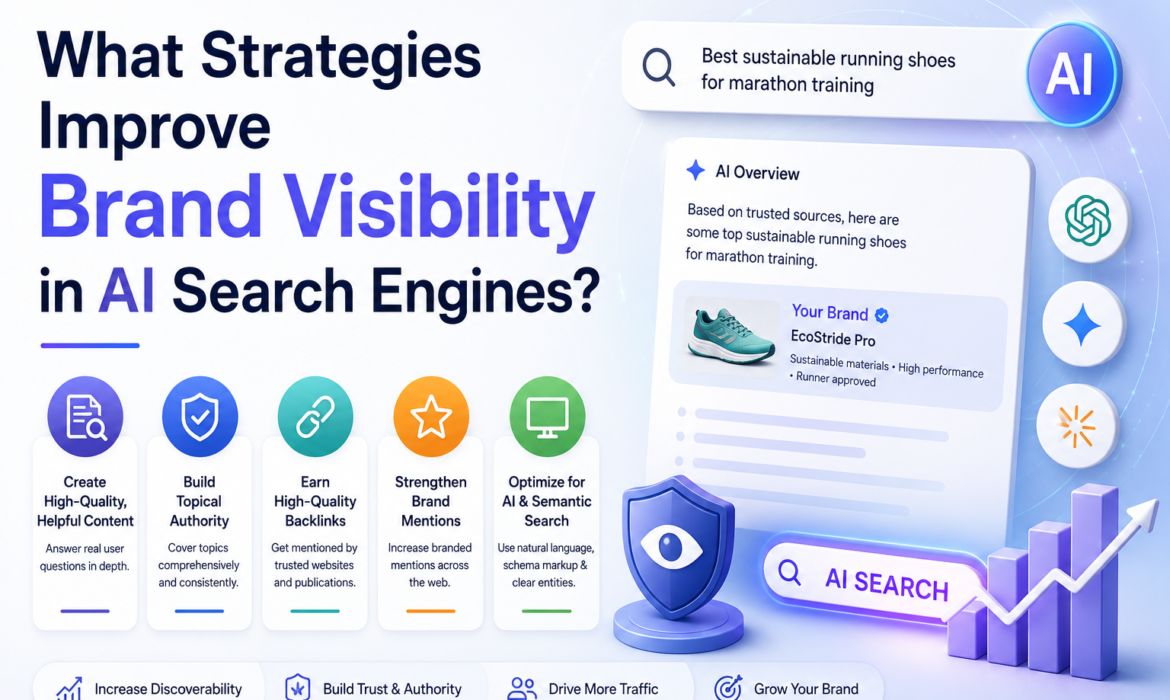
Optimizing your website for large language models (LLMs) and chat-based search interfaces is crucial in today’s AI-driven world. Models like ChatGPT, Copilot, and Google’s Gemini have reshaped how consumers find and interact with brands online. There are some crucial things that you need to do in order to make sure your business stands out.
Table of Contents
ToggleAre you looking for a way to optimize your website for large language models, as well as chat-based search results such as ChatGPT, Perplexity, Google Search, and even things that we are seeing with Copilot in AI? Chat-based search is just going to see more of a proliferation.
Over the next few years, businesses that take the time now to optimize and get ahead of the curve are the ones that are going to succeed. In this article, we will discuss what AI visibility is, why it is important, and the top strategies to improve brand visibility in AI search engines.
What Is Brand Visibility in AI Search?
Brand visibility in AI search means how quickly, favorably, and accurately your website or brand appears in AI search overviews and recommendations. Artificial intelligence tools like AI overviews, GPT, and featured snippets collect data across the web and provide a curated answer directly to users with the compulsion to visit a website.
Brands that want to know how to appear in AI search results in LLMs need to understand some questions about why LLMs consider a brand to show for a response and why not others.
AI vs Traditional Search
The comparison of AI vs. traditional search helps you to interpret AI search results more accurately.
- Traditional SEO: A few years later, we optimize our websites to rank on Google to get enough traffic and ranking. So the success is measured by clicks and traffic that comes to your site.
- AI Search (GEO, AEO): You optimize your brand’s overall digital footprint to be visible across the web. The real success is measured by citations, mentions, and share of voice; for example, how often your brand appears compared to your competitors.
How AI Search Engines Choose Which Brands to Mention
AI search engines work with the Retrieval-Augmented Generation (RAG) model. The specialty of this model is that it retrieves accurate and most relevant information from the index, combines it, and shows the best answer to users.
For example, you are hiring a freelancer. You should not rely only on a self-written bio. You definitely read reviews, testimonials, and comments for better recommendations from people. Similarly, AI does the same task when deciding which brand to mention. They look beyond the company’s website and also consider signals from other trusted sources across the web.
Long story short, the optimization of a site is not enough to appear in AI results. AI search engines look for information from various platforms such as forums, news websites, partner sites, and more. However, to appear in LLM, you need to have a presence across the web, not just your own site.
Top Strategies to Improve Brand Visibility in AI Search Engines
We are going to discuss the top strategies that we can use to improve sites’ visibility and relevance within these models.
Strategy #1: Build Topical Authority
Topical authority is one of the best SEO practices that many people are unaware of. Topical authority means how deeply, comprehensively, and accurately you cover a topic instead of targeting specific keyword pages.
Artificial intelligence prioritizes brands that display consistency and deep command across a topic. To become a topical authority, you need to build clusters that cover a topic comprehensively instead of isolated pages of content.
- Core pillar pages about your brand that explain a topic
- Related or supporting articles that answer specific questions
- Create a hierarchy internally; logically link your content
This approach shows how modern search engines and AI systems work. According to Google guidance, these engines need helpful, detailed, and experienced content rather than generic information.
Strategy #2: Optimize Content for Questions and Conversational Queries
Have you heard of the SEO term “answer engine optimization”? This is a new addition in SEO since AI came. The structure of AI works across questions. According to this methodology, we focus on how real people ask questions about a topic instead of targeting broad keywords.
It contains:
- How-to queries
- Comparison-based questions
- Problem-solution phrasing
- Conversational language
If your content answers directly in a clear or structured way, it can be easily extracted by AI systems.
Strategy #3: Structure Content for AI Readability
AI systems not only read your content but also analyze its structure and understand what it’s about. That is where structured data for AI search matters. Make your content easy to read and scan by using:
- Clear headings and subheadings
- Direct and short answers at the start of the content
- Short paragraphs
- Add lists and bullet points for clarity
- Do schema markup for structured data where relevant
“As Google stated, it uses schema-structured data that it locates on the web to comprehend the content of the page, as well as to gather information about the web and the world in general, such as information about the people, books, locations, or companies that are included in the markup. For instance, when a local business website has JSON-LD structured data (describing the business name, address, phone number, opening hours, and customer rating), Google Search can utilize that information to display a rich result for the local business.”
Strategy #4: Earn High-Quality Brand Mentions
AI search engines not only see your website; they also prefer what other sites say about you. This is where quality mentions come up.
Industry articles, blog posts, reviews, and other third-party websites help AI engines to decide whether this brand is trustworthy or not. The more often your brand is mentioned by a credible source, the stronger your site’s reputation.
For challenger brands, it’s an opportunity. They don’t need to rank on every keyword or outspend the bigger competitors. You just need to be the solution to your audience’s problem in the place where they already trust. Your consistent visibility across the web helps search engines recommend your brand.
Strategy #5: Focus on Semantic Search Optimization
Similar to topical authority, semantic search also makes sense for AI engines to rank your answers in AI search results. You don’t need to repeat the same keywords anymore. Just do that:
- Similar context and entities
- Contextual backlinks
- Topic completeness
- Natural language processing coverage
Google is intelligent enough to understand the relationship between ideas; it never considers them just phrases. This approach helps AI to show your content with a broad range of queries.
For example, a structured AI strategy never covers only “what is content writing”; it also targets related topics such as “what is semantic SEO,” “what is copywriting,” and “what is topical authority.” In this way, you can enlarge visibility instead of chasing every variation manually.
Strategy #6: Align Content with Real User Intent
AI systems are meant to provide the most relevant and helpful answers to readers. That’s why promotional and shallow content is most commonly ignored. The most helpful content should be
- Providing an accurate and real answer to the problem
- Contains clear and actionable insights
- Eliminating difficulties in understanding
Your main focus is to make your content simple, not to publish too much content. Write content that actually solves a problem and helps someone take the next step.
Strategy #7: Optimize for Zero-Click Visibility
“Zero-click” refers to a scenario where users get their answers without visiting a website. Even if your site doesn’t get clicks, showing in search overviews still gets value. It can:
- Make people aware of your brand
- Build trust and credibility
- Lead to more branded searches later
- Shape decisions before the user visits the website
So here the focus changes from getting clicks to getting mentions. To do that, your content should be clear, focused, and easy for AI search engines to understand and repeat.
Strategy #8: Think Beyond Google
AI is not limited to Google or other search engines like Yahoo, Bing, etc.; people are now exploring AI tools like ChatGPT, Perplexity, and other generative tools to find information.
These systems not only rank; they push structured and accurate information to build a trusted answer. Research shows that ChatGPT search ranking is not about traditional ranking; it is about.
- To be a part of trusted sources
- Having clear and authoritative content
- Appearing consistently across the web
As these AI search engines continuously grow, companies and brands need to think about where and how they can rank.
Common Mistakes That Reduce AI Search Visibility
If you want to make your content visible in AI search results, you need to optimize your content for context and machine extraction. Here are some mistakes that you can avoid while optimizing your content to help you achieve your target.
Mistake #1: Your Content Is Not Structured for Machine Understanding
AI only surfaces content that is structured in a way that is easily understandable by machines. Schema markup and clear formatting signal to AI to identify, interpret, and cite these pages.
Mistake #2: Lack Of Enough Trust Signals (EEAT)
AI tools don’t show every piece of content they find. They surface only when they trust. If you write pages with a lack of expertise, they show less authority, freshness, and credibility; they are less likely to appear in AI search results.
Mistake #3: Your Entity Footprint is Inconsistent or Unclear
If your brand is an undefined and inconsistent entity, it refuses to reference you. A uniform, aligned, and clear brand signal helps AI overviews to understand who you are and how your brand fits for this solution.
Mistake #4: Still Writing for Keywords, Not For Conversations
Generative AI tools always ignore content with keyword stuffing. They like that brands answer a question naturally; it feels like they really understand the problem and have the best solution. They always recommend answering a question in the way real people ask.
Mistake #5: Weak UX Signals
Poor user experience creates drawbacks for brands. It sends a message to AI engines that the content is not helpful. Confusing layouts, slow site speed, and accessibility issues decrease engagement and visibility.
How to Measure Brand Visibility in AI Search
It is a process of recognizing how often your brands appear in large language models (LLMs), just like AI overviews, answer engine optimization, perplexity, and ChatGPT. Instead of ranking traditional keywords, your new north star metric is how frequently and prominently AI engines recommend you to users.
1. Key LLMO Metrics (Generative Engine Optimization)
Track these metrics to benchmark your website’s performance.
- Citation rate/frequency
- Share of voice (SOV)
- Brands sentiment
- Positioning
2. Manual Tracking
- Define query sets
- Test across engines
- Record and score
- Calculate the score
3. Automated Tools
- Semrush AI Visibility Toolkit
- Ahref Brand Radar
- Niche AI Trackers
Conclusion
To sum up, improving brand visibility in AI search engines is less about chasing algorithms and more about building trust. Brands that consistently provide valuable information, demonstrate expertise, and maintain a strong online presence are more likely to be recognized and recommended by AI-powered search tools. As search evolves, these remain the key factors that help brands stay visible and competitive.
Frequently Asked Questions
How do I get my brand mentioned in ChatGPT?
Publish definitive content, optimizing for AI queries, earning editorial PR coverage, and generating high-quality, third-party reviews to mention in ChatGPT. This may refer to building a strong association across trusted AI-crawled websites.
Can my brand appear in AI answers without ranking first on Google?
Yes, of course; even if your website is not ranking first on Google, you can appear in AI answers. Google ranking doesn’t matter for AI-rich results. AI tools rank websites on different criteria, allowing you to stand out without organic dominance.
Does SEO still matter for AI search visibility?
Yes, absolutely, SEO still matters, as it acts like a foundation for AI search. Without SEO metrics like on-page SEO, backlinks, structured data, or accessible content, AI engines cannot verify which brand is trustworthy. However, you can say it may change traditional SEO practices.
How do I improve visibility in Google AI Overviews?
Improving your brand’s visibility in Google AI Overviews requires some essential figures. Your content must be optimized for direct answers and structured data and follow the EEAT technique.