
Is your website’s ranking dropping? Do you think you did the SEO correctly? Why is the ranking declining when there are backlinks and high-quality content? Is there any hidden SEO problem that I am missing?
Table of Contents
ToggleThe problem is not with your SEO or content quality. Many SEO writers tend to overlook keyword cannibalization. But repetitive information from content cannibalization and keyword cannibalization really influences how your pages appear in search rankings.
Content cannibalization is not just about the repetition of the same keywords and topics. The real problem starts when multiple pages try to satisfy the same search intent.
In this guide, we’ll talk about what content cannibalization is, how to identify it, and how to fix it. We’ll also discuss common mistakes that can cause this problem in your content and affect your website’s rankings.
What Is Content Cannibalization?
Content cannibalization is an SEO problem that takes place when different pages on the same website target the same or very similar topic, which leads to them competing in search results.
How It Happens in Real Websites
When you are publishing multiple blogs on similar topics and targeting the same keyword with different URLs, this will overlap search intent across pages.
Why It Becomes a Problem
Due to this, Google gets confused about ranking priority. Pages start competing instead of supporting each other. This can split your site’s authority across multiple pages.
Keyword Cannibalization vs Content Cannibalization
Keyword cannibalization is a type of SEO issue that occurs when different pages or blog posts on our website are trying to rank for one keyword.
Key Difference
| Aspect | Keyword Cannibalization | Content Cannibalization |
| Definitions | Various pages target the same keyword | Different pages cover the same topic or keyword intent |
| Core Issues | Keyword overlap | Intent and topic overlap |
| What Competes | Specific keywords | Complete topics and pages |
| SE Confusion | Which one should rank for the keyword | Which one best satisfies user intent |
| Impact | Fluctuating rankings for specific keywords | Drop overall visibility and page authority |
| SEO impact | Weakens keyword ranking | Weakens topical authority |
| Fixing Focus | Adjust or separate keyword targeting | Unify or consolidate overlapping content |
Why People Confuse Them
Because many people think both are the same, as both reduce traffic and weaken the site’s authority as well as its ranking. In both situations, your website’s pages compete with themselves. However, the keyword overlap issue is a surface-level problem, and the content overlap is a deeper-level issue.
Why Content Cannibalization Hurts SEO
Google ranks pages, not topics. Google’s systems analyze individual pages to determine which result best fits a user’s query, according to Google Search Central. So many pages targeting the same keyword or search intent mean they’re splitting signals that should be going to one page.
Weaken Ranking Signals
Google doesn’t like to show too many pages of a website on one keyword. So it limits the number of results per domain. If your website covers multiple pages on the same intent, it can be confused about which one best satisfies the intent. Sometimes it shows only one of them, or sometimes it pushes both of them lower. So one strongly written or optimized page can rank better than several weaker pages competing with each other.
Diluted Authority
Instead of one page getting all the backlinks, the links get spread across several similar pages. This means no single page becomes strong enough to build high authority. As a result, your pages may struggle to rank well in search results because their ranking power is divided.
Search Engine Confusion
It is difficult for Google to figure out which page to prioritize. As a result, your pages could lead to inconsistent rankings. Google also prefers topical authority and can easily see its differences. If your target audience’s intent is unclear and the ratio of content overlap is high, the issues of prioritization still increase, especially for sites that have low-quality pages.
Lower click-through rates
When lots of pages of your website show in search results, clicks can get divided between them. When the wrong page appears in search results, users are less likely to click or interact with it. This can hurt the performance of both pages and reduce overall visibility.
This internal competition often makes it more difficult for any page to rank consistently.
Understanding Search Intent: The Root Cause of Cannibalization
Search intent is what your user is asking you for. Different people search for the same query in different ways, which makes us think that these are different keywords and their intents will also be different. As a result, we write separate articles on these topics, although often they can all be covered in a single comprehensive article.
When we make such a mistake, content cannibalization begins to occur. Multiple pages start targeting the same search intent, which makes it difficult for Google to decide which page to rank for a particular query. That is why understanding search intent is very important. Once you understand the different types of search intent, many concepts related to content planning and cannibalization will automatically become clear.
- Informational: Intent to learn something, looking for information.
- Navigational: The user is looking for a specific website or page.
- Commercial: A person wants to search before he buys anything.
- Transactional: The user is ready to take an action like buying a product.
How to Identify Content Cannibalization Issues
When you create a new site and publish content on it, you see that the site is getting ranked. You write content on various topics and keywords. Try to cover each topic or keyword to build topicality. authority. But unknowingly mix many topics that have similar intent. You have even categorized your pages, but they start competing with each other. So it means you are facing keyword or content cannibalization. Finding and fixing these issues will not only improve the intent of your content but will also improve your ranking.
Issue #1: Analyze Ranking URLs
First, check the queries in Search Console and see if multiple URLs are getting impressions or clicks for the same keywords.
Issue #2: Check Google Search Console
Review the ranking of your pages. Do they rank for the same keywords or search intent? If there is more than one URL ranking for the same queries, they may be competing with each other.
Issue #3: Look for Overlapping Content
Compare the topics, headings, and content of your pages. If different pages are providing the same intent and targeting the same search intent, there may be a content overlap issue.
Issue #4: Review Internal Linking
Check for internal links that are clearly supporting a specific page or giving equal signals to multiple competing pages.
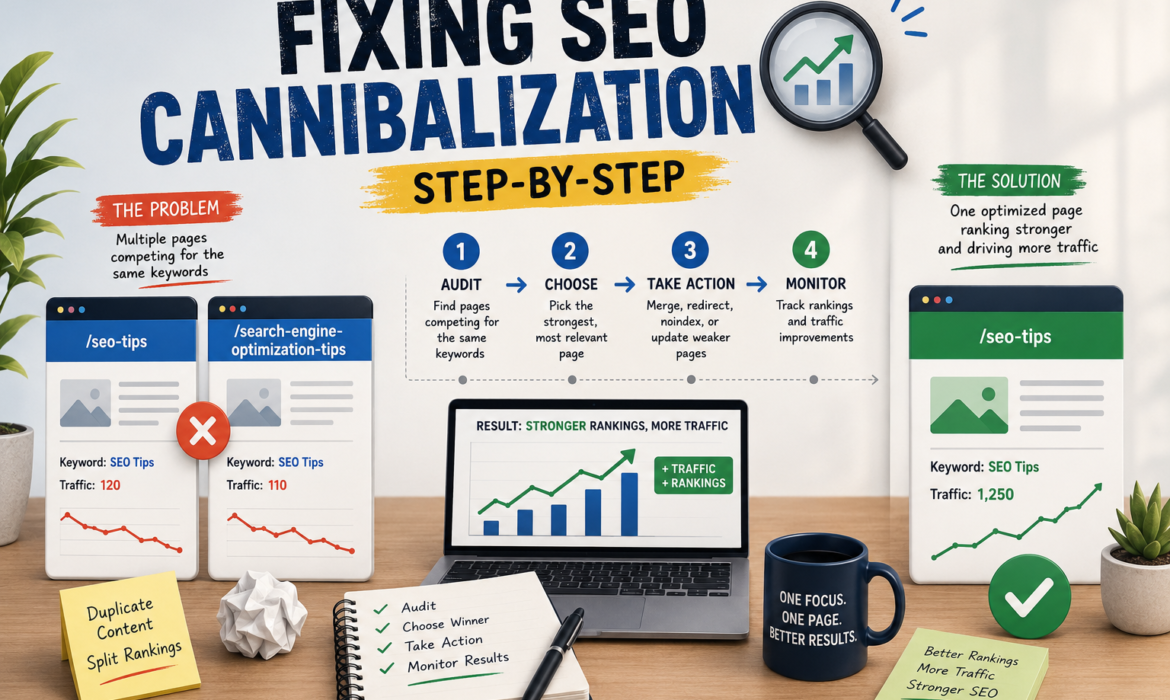
Fixing SEO Cannibalization Step-by-Step
1. Identify cannibalized pages.
- Point out the pages that are ranking for the same keywords.
- Use Google Search Console to check multiple URLs.
- Enter your site’s URL in the console search bar like this: site:yourdomain.com “keyword.”
- To audit the keyword overlap report, use recommended SEO tools (Ahrefs, Semrush, and Ubersuggest).
Primary Goal: To understand which pages are competing with each other.
2. Compare search intent.
- Understand the purpose of each page:
- Are both pages answering the same question?
- Is one informational and the other transactional?
- Is there a real difference or just semantics?
Cannibalization is more likely if the intention is the same.
3. Choose the primary page
- Now decide which page is the main page.
- When choosing a primary page, consider:
- Which page is bringing in the most traffic?
- Which page has the best backlinks?
- Which page is the most complete and high-quality?
- Which page is important for business purposes?
This page will be optimized for the target keywords in the future.
4. Merge or improve content
Now merge the content of the weak pages into the main page.
- Consider the options:
Option A: Merge the pages (best for the same intent)
- Include useful sections on the main page.
- 301 redirect the weak page to the main page.
Option B: Differentiate the pages (if the intent is different)
- If the two pages can serve different intents, then:
- The titles and content are clearly different.
- Target different keywords.
- Include unique examples, FAQs, and user intent.
5. Update internal linking.
Fix links within the website that are pointing to different pages with the same keyword.
What to do?
- Target keyword anchor text on the primary page.
- Internal links to the main page of the relevant pages.
- Avoid ambiguous duplicate anchors.
This gives Google a clear signal of which page is the most important.
6. Improve the main page
Strengthen the main page now:
- Use a clean title tag and H1.
- Add keywords naturally.
- Write Comprehensive content
- FAQs, examples, and updated information have been added.
- Improve page speed and mobile experience
The goal is to give Google a clean, high-quality answer.
7. Monitor results
Performance is revealed after changes.
- Track these metrics:
- Keyword rankings
- Organic clicks
- CTR
- Which URL is ranking now?
Improvements usually start to show in 2-8 weeks
Real Examples of Content Cannibalization
Let’s simplify this topic with real-world examples so everyone can easily understand how content cannibalization happens.
Example #1:
A website has these pages:
- Best SEO Tools
- Top SEO Tools for Beginners
- SEO Tools List 2026
All three target almost the same search intent.
What happens:
Google keeps switching rankings between these pages. None of them becomes the main authority page, so traffic stays weak.
Better approach:
Merge them into one strong page, like Best SEO Tools (2026 Guide).
Example #2:
Pages:
- Home Workout Plan
- Workout Routine at Home
- Bodyweight Exercises at Home
Issue:
They all answer the same user need.
Result:
Instead of one strong ranking page, Google spreads visibility across all three, reducing overall performance.
Example #3:
Pages:
- Running Shoes for Men
- Best Men’s Running Shoes
- Top Running Shoes 2026
Problem:
Same product intent, different URLs competing.
Result:
Google doesn’t know which one to rank, so all pages rank lower than competitor websites with a single optimized page.
Common Mistakes When Fixing Cannibalization
Fixing common cannibalization mistakes can increase rankings, but many people make changes that create new SEO problems. Here is a list of the top common mistakes in fixing cannibalization:
- Delete pages without properly analyzing them
- Ignore search intent
- Write content without improving quality
- Forgetting a 301 redirect
- Unchanged internal linking
- Changing URLs unnecessarily
- Focus only on exact-match keywords
- Not monitoring results after fixing
- Fixing pages that are not actually cannibalizing
- Similar to other issues, treating cannibalization as a one-time task
When Cannibalization Is Not a Problem
Not every case of content cannibalization requires immediate action. Sometimes multiple pages rank because they serve different user intents. When both pages serve different purposes, having multiple rankings can actually bring in more traffic.
Pages Target Different Search Intent
There are various websites ranked with multiple pages on the same topic without any issues. Generally, this happens when each page answers a different question or targets a different stage of the user’s journey. When that happens, the site occupies more space in the search results, which can increase clicks and visibility.
Topic Clusters and Supporting Content
Brands organize their site content around a main niche and then create supporting articles that explore related subtopics or keywords. Although these pages naturally share keywords, they usually work together rather than compete against one another.
PageRank for Different Keyword Variations
People know that search engines don’t rank pages for just one keyword. One article may attract users searching for broad information, while another performs better for more specific searches. So in this way, both pages can generate valuable traffic to the website.
Different Content Formats Serve Different Users
Everyone writes articles in different styles. Some users need a detailed guide, while others find a comparison page, video, or case study. That’s why multiple pages on a similar topic can often coexist without creating cannibalization issues.
Local and National Pages Can Coexist
Suppose a plumbing company has one page to serve internationally and separate pages for local cities like Lahore, Karachi, or Islamabad. These pages aren’t trying to rank for the exact same audience. Someone looking for a plumber in Karachi has different needs from someone searching for general information about plumbing services.
Performance Metrics Remain Strong
Don’t rush to merge pages just because they target similar keywords. If both articles are already bringing in traffic and helping the site generate leads or sales, changing them could create a problem that didn’t exist in the first place.
Key Takeaway
The most important thing is that keyword overlap alone doesn’t automatically mean there’s a problem. You need to analyze by yourself whether the pages are competing for the same intent or helping users in different ways. If each page has a clear purpose and performs well, there may be no reason to merge or remove anything.
How to Prevent Content Cannibalization in the Future
It is a helpful practice to prevent content cannibalization in the future for your site’s permanent growth. After great research, I have gathered simple and easy steps of SEO that can help to keep your content organized and decrease the chances of various pages competing for the same search intent.
Plan Content Before Publishing
Check published pages before writing new content to avoid covering the same topic many times.
Focus on Search Intent
Be aware of user intent when writing your content rather than targeting every keyword variation with a separate article.
Perform Regular Content Audits
Audit your site every week to check for duplicate content and fix issues early.
Use Inbound Links Wisely
Link related pages strategically to help search engines understand which page should rank.
Keep a Content Map
Maintain a record of your topics and target keywords to prevent future overlap.
Content Should Work Together, Not Compete
Here’s the thing. Most cannibalization issues don’t happen because someone made a huge SEO mistake. They happen because content keeps getting published and nobody stops to check what’s already on the site.
If you are also stuck in this problem, check your content first, and then make a strategy for which content needs to be written or which should not. Follow our guidelines and free yourself from the content cannibalization issue permanently.
Frequently Asked Questions
Can service pages be cannibalized?
Yes, service pages can also be cannibalized. Because you have created multiple pages on your site for similar services, they end up trying to rank for the same thing. They start competing with each other instead of assisting your site. For example, two pages talking about almost the same SEO service can confuse search engines about which one to show.
Should I delete or merge cannibalized pages?
It depends. If one page is clearly performing better, merging usually works well. But if both pages are still getting traffic or feel slightly different, don’t delete anything. Just improve them so each one has a clear purpose.
What is the 80/20 rule for SEO?
In SEO, it’s usually your small group of pages that brings most of the traffic. The rest often don’t do much. That’s why people don’t just keep publishing new stuff blindly. They go back and improve the pages that are already working, because that’s where the real results usually come from.
What are the strategies for keyword cannibalization?
First, figure out which pages are overlapping. Then decide what each page should actually focus on. You may merge content; sometimes you rewrite sections so each page has a clear purpose. Internal linking also helps a lot because it tells search engines which page is more important.